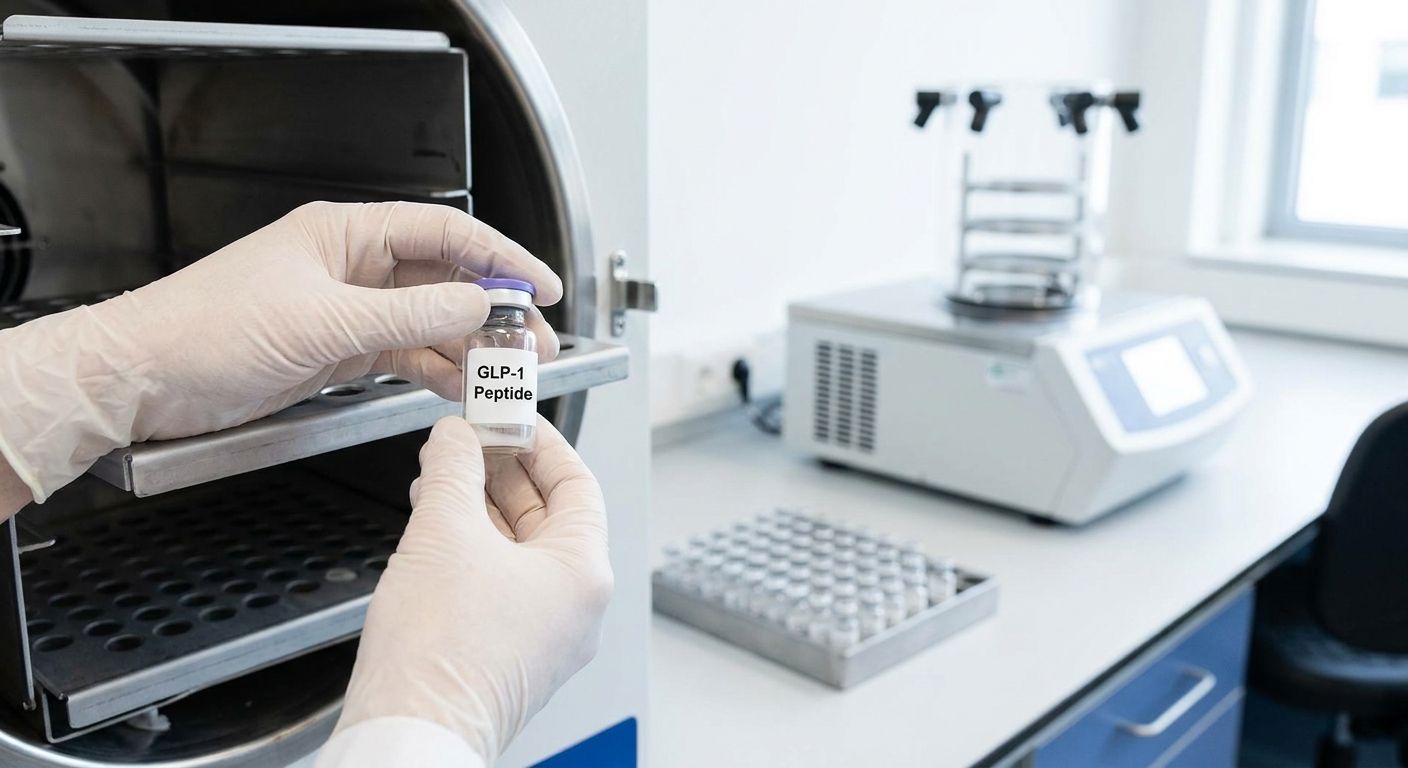
Every GLP-1, GIP, and glucagon-receptor triple agonist trial published since 2021 has moved the goalposts on what "efficacious" looks like in metabolic research, and picking the wrong peptide analog for a study protocol wastes both budget and lab time. This glp-1 clinical evidence review breaks down what the published trial data actually shows for semaglutide, tirzepatide, and retatrutide analogs, and which sourcing decisions matter once you've read the papers.
- Semaglutide's STEP 1 trial (NEJM, 2021) showed 14.9% mean weight loss at 68 weeks — the benchmark GLP-1 dataset for 2026 protocol design.
- Tirzepatide's SURMOUNT-1 data (NEJM, 2022) hit 20.9% at the 15mg arm over 72 weeks, ahead of single-agonist molecules.
- Retatrutide's phase 2 data (NEJM, 2023) reported 24.2% at 48 weeks on the 12mg dose — the highest figure in this glp-1 clinical evidence review, with phase 3 still running.
- Glp-123's semaglutide, tirzepatide, and retatrutide research peptide lines are the three picks worth stocking for 2026 protocols — all Buy verdicts below.
- Skip vendors that can't produce a lot-specific certificate of analysis; that's the single biggest quality gap in this category.
Why this matters
Most buying guides for research peptides talk purity and price and skip the part that actually drives procurement decisions: what does the published clinical evidence say about the molecule you're ordering. A lab that orders retatrutide analog expecting semaglutide-level trial maturity is going to misdesign its study.
The three molecules behind the current GLP-1 research wave — semaglutide, tirzepatide, and retatrutide — sit at different points on the evidence timeline in 2026. Semaglutide has the longest published trial record. Tirzepatide has the strongest dual-agonist dataset. Retatrutide has the biggest single reported effect size but the thinnest long-term data. Sourcing decisions should follow that hierarchy, not marketing copy.
Glp-123's research peptide catalog spans all three analogs, which makes it a useful anchor for comparing what the literature actually supports against what's on the shelf.
Who this is for
This review is built for lab buyers designing metabolic study protocols — university researchers, biotech procurement leads, and contract research organizations who need to match a peptide order to a specific published dataset before a study starts, not after. If you're sourcing for veterinary metabolic studies or a compliance-audited lab, the same evidence hierarchy applies; you're just weighting documentation criteria higher.
What to look for in GLP-1 research peptides for evidence-based protocols
Peptide identity matched to a specific trial arm
The molecule you order needs to match the dosing arm you're citing, not a rounded-off version of it. Semaglutide, tirzepatide, and retatrutide are not interchangeable in a protocol write-up — each has a distinct receptor profile and a distinct trial dataset behind it, and reviewers will catch a mismatch.
Third-party purity verification
A certificate of analysis with lot-specific HPLC purity data is the only way to know what's actually in the vial. Published trial data assumes a known-purity compound; a peptide without a CoA can't be reliably tied back to the literature you're citing.
Reconstitution consistency
Dosing accuracy in a study depends on getting bacteriostatic water ratios and vial concentrations right every time, not most of the time. Inconsistent reconstitution introduces variance that has nothing to do with the molecule and everything to do with technique.
Cold chain and storage stability
Lyophilized peptides degrade faster than most buyers expect once temperature control slips. A supplier's cold chain shipping and freezer storage practices determine whether the compound you receive still matches the purity on its CoA.
Documentation for compliance-focused labs
University IRBs and CRO audit trails need batch-level paperwork, not a generic quality statement. This matters more for retatrutide analogs right now, since the trial record is thinner and every documentation gap gets scrutinized harder.
Supplier traceability
Gray-market peptide sourcing is common enough in this category that traceability is a real filter, not a formality. A supplier that can show batch history end to end is the one whose product actually lines up with the clinical evidence you're referencing.


Top picks by trial data
Semaglutide analog — the evidence-anchored pick. STEP 1 reported 14.9% mean weight loss at 68 weeks against 2.4% for placebo (NEJM, 2021). It has the longest published trial trail of any molecule in this review, which makes it the safest choice when a protocol needs to cite settled literature. Glp-123's semaglutide research peptide line matches this dosing class. Verdict: Buy.
Tirzepatide analog — the high-effect-size pick. SURMOUNT-1's 15mg arm posted 20.9% mean weight loss at 72 weeks (NEJM, 2022), roughly six points ahead of the semaglutide benchmark. Dual GIP/GLP-1 agonism is the mechanism reviewers ask about most in 2026 grant applications, so this analog carries weight in a proposal. Glp-123's tirzepatide research peptide is built for exactly this dosing tier. Verdict: Buy.
Retatrutide analog — the frontier pick. Phase 2 data put the 12mg dose at 24.2% mean weight loss over 48 weeks (NEJM, 2023) — the largest single reported effect size in this review. Phase 3 trials are still running as of 2026, so the long-term dataset isn't settled yet; treat this as the molecule to study, not the one to build a final claim around. Glp-123's retatrutide research peptide covers the triple-agonist dosing range. Verdict: Consider.
What to avoid
- "Clinical grade" language with no CoA behind it. That phrase means nothing without lot-specific HPLC data attached — it's marketing, not a spec.
- Vial concentrations that don't map to any published trial arm. If the dose doesn't correspond to a dataset you can cite, your protocol write-up has a hole in it.
- Suppliers with no cold chain documentation. A degraded lyophilized peptide will still look fine on paper and behave nothing like the compound in the trial you're referencing.
Verdict comparison
| Molecule | Trial data point | Duration | Verdict |
|---|---|---|---|
| Semaglutide analog | 14.9% mean weight loss (STEP 1, NEJM 2021) | 68 weeks | Buy |
| Tirzepatide analog | 20.9% mean weight loss (SURMOUNT-1, NEJM 2022) | 72 weeks | Buy |
| Retatrutide analog | 24.2% mean weight loss (Phase 2, NEJM 2023) | 48 weeks | Consider |
FAQ
What is the strongest published clinical evidence for GLP-1 research peptides in 2026?
Semaglutide has the deepest published record, anchored by the STEP 1 trial's 14.9% mean weight loss at 68 weeks (NEJM, 2021). Tirzepatide and retatrutide have shorter but stronger effect-size data as of 2026.
Is tirzepatide better than semaglutide based on trial data?
On reported effect size, yes — SURMOUNT-1 showed 20.9% mean weight loss versus semaglutide's 14.9%, both at roughly comparable durations. Semaglutide still has the longer published trial history behind it.
How mature is the retatrutide clinical evidence base?
Retatrutide's largest published dataset is a 48-week phase 2 trial (NEJM, 2023) showing 24.2% mean weight loss at the 12mg dose. Phase 3 data was still pending as of 2026, so long-term evidence is thinner than for semaglutide or tirzepatide.
What should a lab check before ordering a GLP-1 research peptide?
Confirm a lot-specific certificate of analysis with HPLC purity data before ordering. Without it, there's no reliable way to tie the compound in hand to the trial dataset you're citing.
Why does cold chain shipping matter for peptide research?
Lyophilized peptides degrade when temperature control lapses in transit, which changes effective purity without changing the label. A documented cold chain is the only way to trust the CoA on arrival.
How does GLP-1 clinical evidence review differ for university labs versus CROs?
University labs generally weight IRB-facing documentation heaviest, while CROs weight batch traceability for client audits. Both groups still need the same underlying purity and trial-matching criteria.
Are triple agonists like retatrutide replacing dual agonists in research protocols?
Not yet as of 2026 — retatrutide's effect size is larger in early data, but tirzepatide's dual-agonist dataset is more established for protocol design that needs settled comparisons.
One last thing
The detail most buyers miss: retatrutide's 24.2% figure at 48 weeks (NEJM, 2023) is the highest reported weight-loss effect size of any molecule in this review, and it came from a phase 2 trial — a smaller, shorter study than the phase 3 datasets behind semaglutide and tirzepatide. Cite it accordingly.