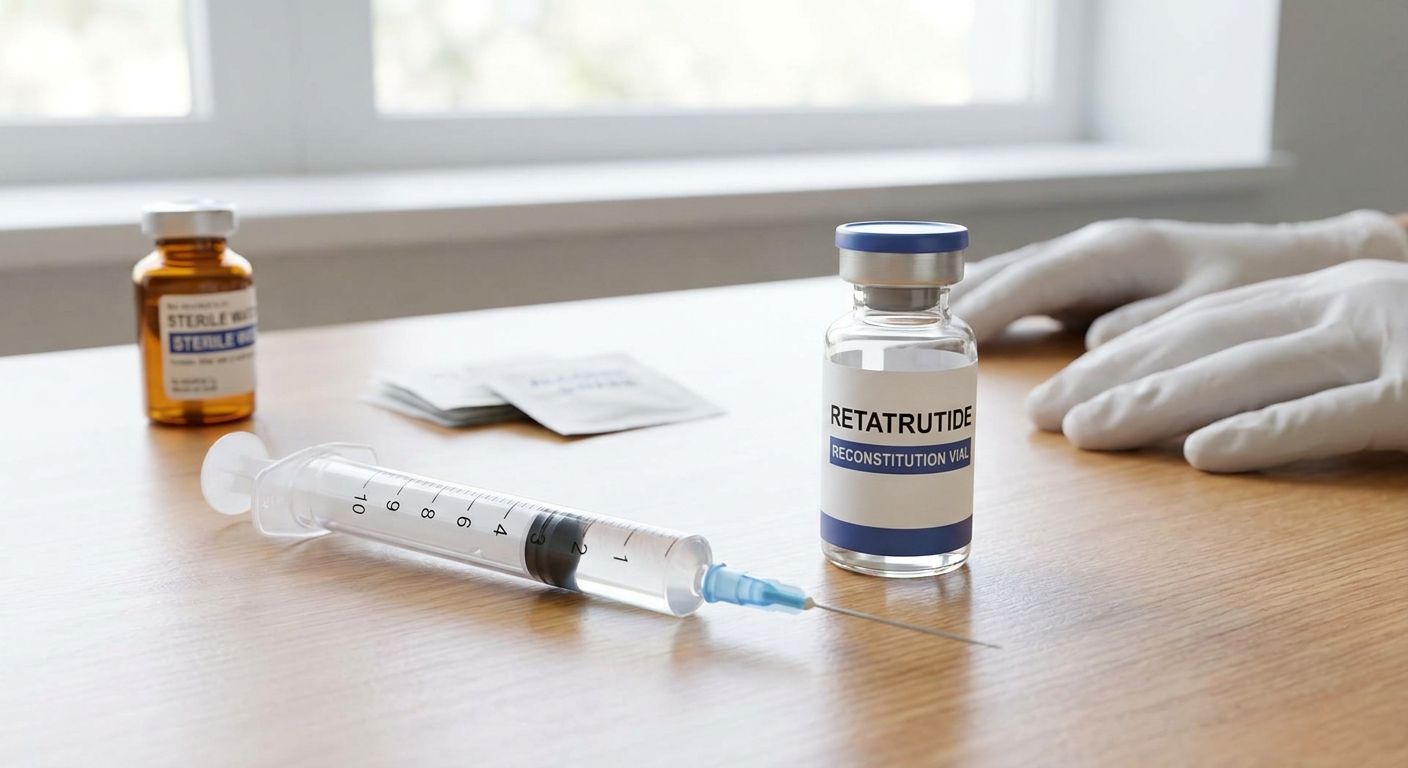
Retatrutide vial prep goes wrong more often at the syringe than at the peptide. Picking the right barrel size, needle gauge, and dead-space design determines how much of your reconstituted peptide actually ends up in solution instead of wasted in the hub.
- A 0.3 mL low dead-space insulin syringe is the safe pick for retatrutide vials reconstituted with bacteriostatic water in 2026 - buy it.
- 3 mL Luer lock syringes work for bulk bacteriostatic water draws but waste volume on small peptide transfers - consider only for prep, not final draw.
- Skip 21-27G needles for piercing rubber stoppers repeatedly - they core the septum and introduce particulates.
- Fixed-needle U-100 syringes with 0.01 mL graduations give the most repeatable reconstitution math for retatrutide research protocols.
Why this matters
A syringe is not an interchangeable accessory when you're reconstituting research peptides - the barrel volume, needle gauge, and dead space all change how much liquid actually transfers and how much peptide gets trapped or degraded at the stopper. Get the syringe wrong and you introduce measurement error before the research protocol even starts. This guide breaks down what matters for retatrutide vial prep in 2026, based on syringe design specs, not guesswork.
Who this is for
This guide is built for lab technicians, university biotech researchers, and independent researchers at Glp-123 who handle retatrutide vials and need consistent, low-error reconstitution technique. If you're drawing bacteriostatic water into a peptide vial and expect the graduation marks to mean something, this is your buyer profile. It assumes research-only use in a controlled lab setting - not clinical administration.
What to look for in a syringe for reconstituting peptides
Barrel volume matched to your reconstitution volume
If you're adding 2 mL of bacteriostatic water to a retatrutide vial, a 1 mL syringe means multiple draws and more room for error. Match barrel size to the total diluent volume in one pass whenever possible - fewer transfers means fewer chances to introduce air or contamination.
Low dead space
Standard syringes trap roughly 0.07 mL of liquid in the hub and needle after every draw; low dead-space (LDS) designs cut that closer to 0.01 mL. For small-volume peptide work, that difference is the gap between an accurate concentration and a guess.
Needle gauge for the job
A 27-31G needle is standard for drawing bacteriostatic water and reconstituting through a rubber stopper without coring it. Thicker needles (18-23G) belong on bulk diluent transfers from larger stock bottles, not on repeated stopper punctures.
Graduation increments
0.01 mL or 1-unit markings let you read small reconstitution volumes without interpolating between lines. If the barrel only marks every 0.1 mL, your measurement error compounds fast on a 0.2-0.3 mL draw.
Luer lock vs slip tip
Luer lock needles screw on and don't pop off mid-draw, which matters when you're pulling from a bacteriostatic water vial under any resistance. Slip tips are fine for single, low-pressure draws but riskier for repeated use.
Sterile, single-use packaging
Every syringe touching a retatrutide vial should come from sealed, single-use packaging. Reusing a syringe across vials - even the same peptide - risks cross-contamination and clouds your research data.
Top picks for retatrutide vial prep
The precision pick: 0.3 mL insulin syringe, 31G, low dead space. This size is built for small reconstitution draws and final measurement, with 0.01 mL graduations and roughly 0.01 mL dead space versus 0.07 mL on standard designs. It's the syringe most researchers reach for once the vial is reconstituted with bacteriostatic water for retatrutide and it's time to measure. Buy.
The safe pick: 1 mL fixed-needle insulin syringe, 29G. Slightly larger barrel for vials reconstituted with 1-2 mL of diluent, still fine enough gradation to avoid rounding errors. Fixed needles remove one failure point since there's no needle-hub seal to leak. Buy.
The bulk-prep pick: 3 mL Luer lock syringe with detachable 21G needle. Use this only for pulling bacteriostatic water out of a larger stock vial before transferring to the retatrutide vial - not for the final measured draw. The barrel is too coarse for precise peptide dosing math, and the wider dead space wastes more diluent than a small-volume syringe would. Consider, prep stage only.
The wildcard: multi-dose vial adapter with attached syringe port. Useful in a lab running frequent draws from the same vial over several sessions, since it reduces the number of stopper punctures over the vial's working life. Retatrutide and tirzepatide research peptide protocols that call for repeated small draws benefit most from this setup. Consider if your protocol spans multiple sessions per vial.
Skip: any syringe with a needle gauge above 23G for the final peptide draw. Wider needles core more rubber out of the stopper with every puncture, and that rubber debris can end up in solution. Reserve wide-bore needles for diluent transfer only, never for the vial you're about to sample from.
Source your reconstitution supplies
Browse retatrutide and tirzepatide research peptides plus bacteriostatic water.
What to avoid
- Reusing a syringe across vials. Even rinsed, a used syringe carries residue that can skew concentration in your next reconstitution.
- Mismatched needle gauge for bacteriostatic water reconstitution. A gauge built for injection isn't automatically right for drawing diluent - check both ends of your protocol, especially when working with bacteriostatic water for tirzepatide reconstitution alongside retatrutide vials in the same session.
- Skipping graduation checks on cheap syringe lots. Bulk-sourced syringes vary more in barrel tolerance than name-brand insulin syringes - if the numbers matter to your protocol, verify a sample before committing to a case.
Verdict comparison table
| Syringe type | Volume | Needle gauge | Dead space | Best use | Verdict |
|---|---|---|---|---|---|
| Insulin syringe, LDS | 0.3 mL | 31G | ~0.01 mL | Final measured draw | Buy |
| Insulin syringe, fixed needle | 1 mL | 29G | ~0.02 mL | Standard reconstitution | Buy |
| Luer lock, detachable | 3 mL | 21G | ~0.07 mL | Bulk diluent transfer | Consider |
| Vial adapter + syringe port | Varies | N/A | Low, adapter-dependent | Multi-session vials | Consider |
| Wide-bore syringe | Any | 18-20G | High | Not for final draw | Skip |
Purity of the underlying peptide matters just as much as syringe choice - a precise draw from a low-purity vial still gives you unreliable data. Check sourcing on high-purity peptides for laboratory research before you standardize a reconstitution protocol around any single vial batch.
FAQ
What is the best syringe for reconstituting peptides in 2026?
A 0.3-1 mL low dead-space insulin syringe with 29-31G needle and 0.01 mL graduations is the standard choice for reconstituting research peptides like retatrutide in 2026. It minimizes wasted volume and gives the most repeatable measurement.
Is a 1 mL syringe better than a 0.3 mL syringe for retatrutide vial prep?
A 1 mL syringe works better for larger reconstitution volumes, while a 0.3 mL syringe gives finer graduation for small, precise draws. Match barrel size to your actual diluent volume rather than defaulting to one size.
What needle gauge should I use to reconstitute a peptide vial?
27-31G needles are standard for puncturing a rubber stopper repeatedly without coring it. Wider gauges above 23G are better reserved for transferring bulk bacteriostatic water, not the final peptide draw.
Why does dead space matter in a reconstitution syringe?
Dead space is the small volume of liquid trapped in the needle and hub after each draw, typically around 0.07 mL in standard syringes versus 0.01 mL in low dead-space designs. On small-volume peptide work, that trapped liquid changes your effective concentration.
Can I reuse a syringe for multiple retatrutide vials?
No, a syringe should be single-use per vial to avoid cross-contamination and residue carryover. Sterile single-use packaging is a baseline requirement, not an optional upgrade.
Do I need a Luer lock or slip tip syringe for peptide reconstitution?
Luer lock syringes are safer for repeated draws since the needle screws on and won't detach under resistance. Slip tips are acceptable for single, low-pressure draws but carry more risk on repeated use.
How much bacteriostatic water do I need to reconstitute a retatrutide vial?
The diluent volume depends on the specific vial and research protocol you're following, so check the vial's documentation rather than a general rule. Match your syringe barrel size to whatever that volume turns out to be.
What syringe graduation is precise enough for peptide research work?
0.01 mL or 1-unit graduations are precise enough for most small-volume peptide reconstitution work in 2026. Barrels marked only every 0.1 mL force interpolation and introduce more measurement error.
One last thing
The dead-space gap between a standard syringe and a low dead-space one - roughly 0.07 mL versus 0.01 mL - sounds tiny until you're running the same reconstitution protocol across dozens of vials in 2026. Over a full case of retatrutide vials, that trapped volume adds up to a measurable amount of wasted peptide, and it's the single easiest fix on this entire list.