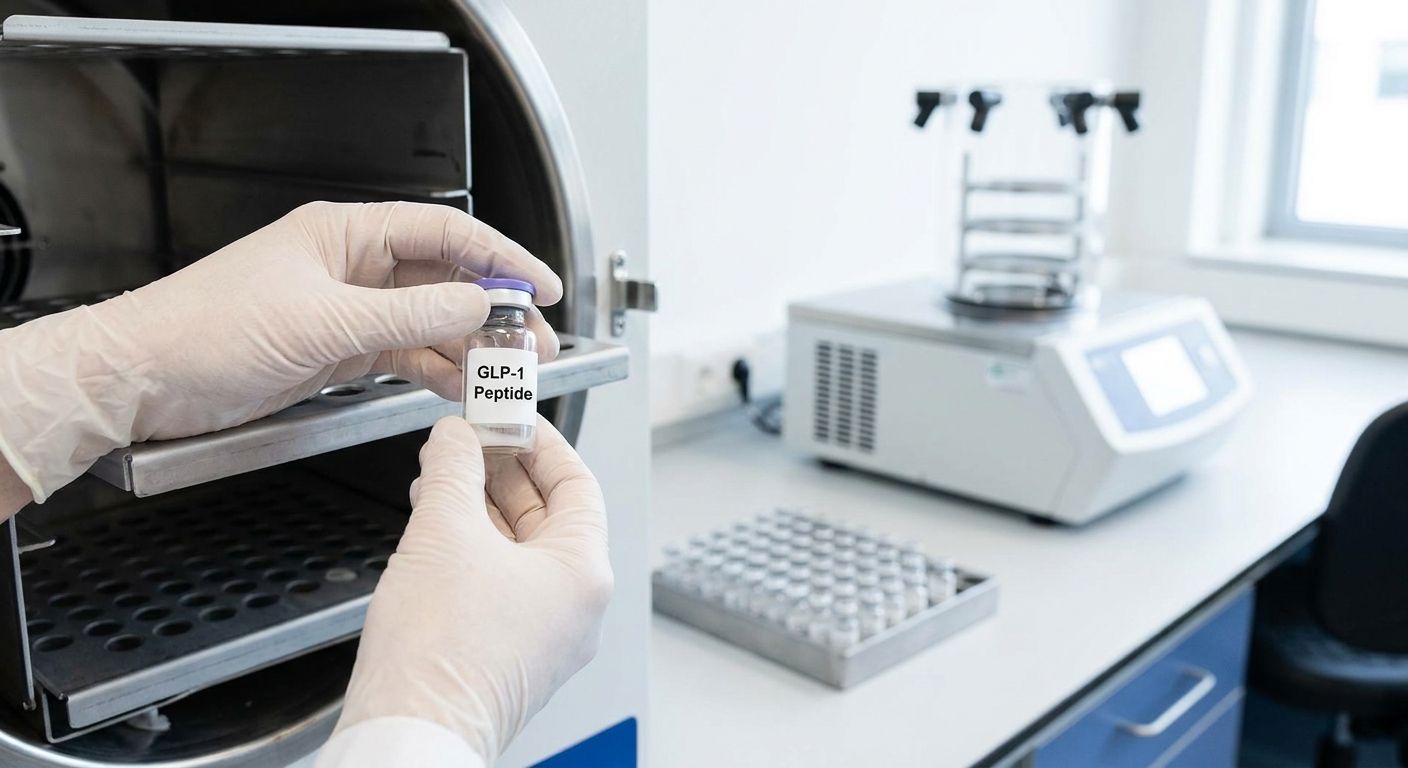
GLP-1 reference standards are what separate a defensible chromatography result from a guess — and for anyone running HPLC or LC-MS on semaglutide, tirzepatide, or retatrutide, the standard you calibrate against matters as much as the instrument itself.
- Semaglutide, tirzepatide, and retatrutide reference peptides need a batch-specific COA before they belong in any 2026 calibration curve.
- GLP-123 stocks lyophilized reference vials from 5mg to 60mg — buy the size that matches your assay range, not the cheapest unit.
- Skip any glp-1 reference standards listing with no purity documentation or batch number; that vial is a liability, not a control.
- Retatrutide (triple-agonist) reference peptides run $34-$78 per vial in 2026 depending on quantity — verdict: Consider for comparative studies, Buy for validated protocols.
- Bacteriostatic water with 0.9% benzyl alcohol is the standard diluent — reconstituted vials degrade past a 28-day window regardless of peptide quality.
Why This Matters
A GLP-1 reference standard exists to answer one question: is the peak on your chromatogram actually the compound you think it is, at the concentration you think it's at. Without a characterized standard, retention time and mass spec confirmation are just informed guesses.
Labs running metabolic-peptide research on semaglutide, tirzepatide, or retatrutide need that certainty more in 2026 than in prior years, because assay panels have gotten more crowded — triple-agonist molecules like retatrutide now share HPLC methods with dual- and single-agonist compounds, and cross-contamination in method validation is easy to miss without a clean control. GLP-123 stocks lyophilized reference peptides across all three classes, which is the practical reason this guide exists.
Who This Is For
This is for analytical chemists, QC technicians, and university or CRO research staff who need a characterized GLP-1 agonist peptide to calibrate instruments, validate methods, or run comparative studies — not for anyone looking for a peptide to administer. If your work involves HPLC calibration curves, mass spec confirmation, or batch-release testing on semaglutide, tirzepatide, or retatrutide analogs, the criteria below apply directly to your purchasing decision.
What to Look For in GLP-1 Reference Standards
Purity documentation on the batch you receive
A certificate of analysis tied to the specific lot in your hands is non-negotiable — a generic spec sheet for "the product line" doesn't tell you what's actually in the vial you opened. Request batch-specific COA data before you build a calibration curve around it; a standard with unverified purity introduces error you can't quantify later.
Lyophilized format over pre-mixed liquid
Lyophilized (freeze-dried) peptide holds stability far longer than a pre-reconstituted liquid sitting on a shelf. For reference material you may not use for weeks, lyophilized format buys you a stability margin that liquid product simply doesn't have.
Vial size matched to your calibration range
A 5mg vial and a 60mg vial serve different purposes — the smaller size suits single-point spike-and-recovery work, while larger vials make sense when you're running a multi-point curve across a full assay validation. Buying the wrong size means either wasting expensive standard or running out mid-study.
Reconstitution compatibility
The bacteriostatic water and syringe you use to reconstitute a reference standard affect the result as much as the peptide itself. A 0.9% benzyl alcohol bacteriostatic water is the standard diluent for these preparations, and mismatched syringe gauge introduces variability in dilution accuracy.
Cold chain integrity in shipping
Lyophilized peptide is more forgiving in transit than reconstituted liquid, but temperature excursions during shipping still degrade even freeze-dried material over time. Ask how the vial was packaged and shipped before you trust the purity claim on arrival.
Documentation depth for compliance-focused labs
University IRB reviews, CRO audits, and internal QA all want a paper trail — batch numbers, COA, and third-party test results need to be retrievable, not just claimed on a product page.
Top Picks for GLP-1 Reference Standard Research
Semaglutide reference peptide — the safe pick. Semaglutide is the most-cited GLP-1 agonist in published assay methods, which makes it the standard most labs calibrate against first. GLP-123's semaglutide research peptide for laboratory studies lists lyophilized vials at 10mg and 20mg. Verdict: Buy for any single-agonist calibration work in 2026.
Tirzepatide reference peptide — the volume pick. Tirzepatide's dual GIP/GLP-1 mechanism means it needs its own calibration curve separate from single-agonist compounds — you cannot substitute a semaglutide standard here. GLP-123's tirzepatide research peptide for metabolic studies page runs sizes from 15mg through 60mg lyophilized vials, giving labs room to scale a multi-point curve without re-ordering mid-study. Verdict: Buy if your protocol includes dual-agonist comparison.
Retatrutide reference peptide — the wildcard. Retatrutide's triple-agonist mechanism (GIP/GLP-1/glucagon) is newer to published methods than semaglutide or tirzepatide, so fewer labs have validated assays against it yet. GLP-123's retatrutide research peptide for triple agonist studies page offers vials from 5mg to 20mg. Verdict: Consider — solid for comparative and exploratory work in 2026, but confirm your method is validated for a triple-agonist target before treating results as definitive.
Bundled reconstitution kit — the convenience pick. A kit pairing a lyophilized vial with bacteriostatic water and a sterile syringe removes one variable: mismatched dilution supplies. This works when your lab is standing up a new protocol and wants every component from one lot. Verdict: Buy for setup speed; Skip if your lab already has validated reconstitution supplies on hand and just needs the peptide.


What to Avoid
- Unlabeled "research blend" listings with no batch number. A vial without a traceable lot number can't be tied to a COA, which means you're calibrating against an unknown.
- Marketing language that leans human-use. A genuine GLP-1 reference standard for lab work reads like a lab product — spec sheet, storage instructions, purity data — not like a consumer wellness pitch.
- Pre-reconstituted liquid sold as long-shelf-life standard. Lyophilized peptide holds stability; liquid product sitting in a warehouse does not, regardless of what the listing claims.
Verdict Comparison
| Reference Peptide | Purity Documentation | Vial Sizes | Best For | Verdict |
|---|---|---|---|---|
| Semaglutide (GLP-1SG) | COA available | 10mg, 20mg | Single-agonist calibration | Buy |
| Tirzepatide (GLP-2TZ) | COA available | 15mg-60mg | Dual-agonist assay validation | Buy |
| Retatrutide (GLP-3RT) | COA available | 5mg-20mg | Triple-agonist comparative studies | Consider |
| Unlabeled blend (generic) | None | Unlisted | Nothing defensible | Skip |
FAQ
What is a GLP-1 reference standard used for?
A GLP-1 reference standard calibrates HPLC or LC-MS instruments so a lab can confirm the identity and concentration of a peptide peak. It's a control, not a product intended for administration.
How is a reference standard different from a research peptide kit?
A reference standard is a characterized peptide with batch-specific purity data used for calibration, while a research peptide kit typically bundles the peptide with reconstitution supplies for general lab use. Both should carry a COA, but the reference standard's documentation needs to trace to the exact lot in the vial.
Is semaglutide reference standard the same as tirzepatide reference standard?
No, they are structurally different molecules with different mechanisms — semaglutide is a single GLP-1 agonist, tirzepatide is a dual GIP/GLP-1 agonist. Each needs its own calibration curve; one cannot substitute for the other in method validation.
How much does a GLP-1 reference standard cost in 2026?
Vials on GLP-123 range from $34.00 for a 5mg retatrutide kit to $85.00 for a 60mg tirzepatide vial in 2026. Price scales mostly with peptide quantity per vial.
What purity documentation should a GLP-1 reference standard include?
Look for a certificate of analysis tied to the specific batch number on the vial, not a generic product-line spec sheet. Third-party test results add a second layer of confirmation for compliance-focused labs.
How should lyophilized GLP-1 peptides be stored?
Lyophilized peptide should stay refrigerated or frozen and protected from light until reconstitution. Once reconstituted with bacteriostatic water, most labs treat the solution as degrading past a 28-day window, consistent with standard multi-dose vial practice.
Can retatrutide reference standards be used for triple-agonist assay validation?
Yes, retatrutide reference peptide works for triple-agonist (GIP/GLP-1/glucagon) comparative and validation studies. Confirm your specific method has been validated against a triple-agonist target before treating results as final.
Where can labs buy GLP-1 reference standards online?
GLP-123 sells lyophilized semaglutide, tirzepatide, and retatrutide reference peptides directly, each listed with vial size and pricing. Check for batch-specific documentation on any listing before ordering.
One Last Thing
Most reference-standard failures trace back to reconstitution, not the peptide itself. Bacteriostatic water carrying 0.9% benzyl alcohol is standard for a reason — it's the preservative that keeps a multi-use vial viable — but once you puncture it, the clock is running. A lab that stores an opened 10mL vial past the conventional 28-day window and then wonders why its calibration curve looks off is testing degraded diluent, not a bad standard.