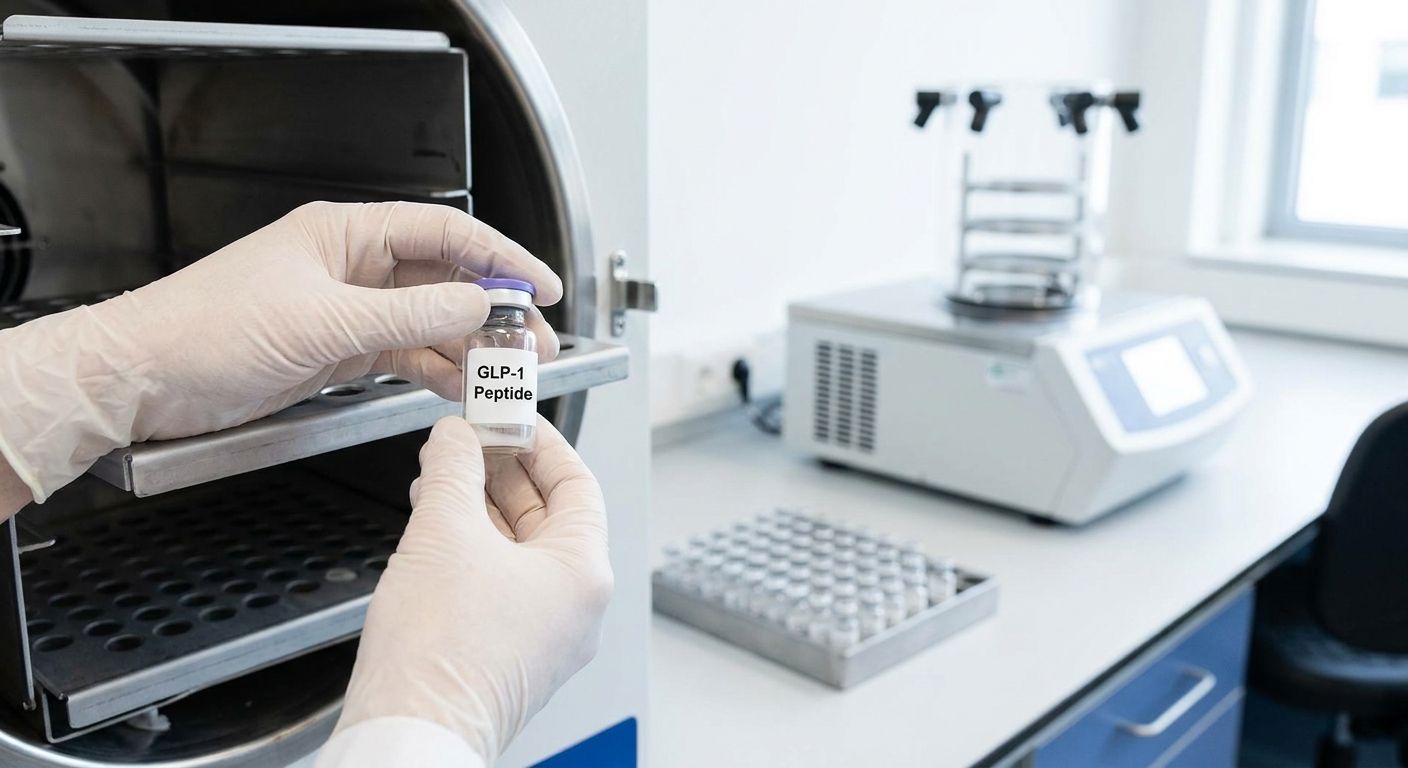
GLP-1 stress-testing research protocols determine how tirzepatide, semaglutide, and retatrutide research peptides degrade under heat, light, agitation, and freeze-thaw cycling — the data that decides whether a lab's storage and handling procedures actually hold up.
- GLP-1 stress testing in 2026 follows ICH Q1A(R2)-style conditions: 40°C/75% RH accelerated and 2-8°C long-term storage arms.
- Reference standards with documented lot traceability are non-negotiable for comparability work — buy them, don't skip this step.
- Bacteriostatic water reconstitution consistency is the most overlooked variable in stress-testing baselines. Verdict: standardize it first.
- Lyophilized peptide storage at -20°C outperforms refrigerated storage for long-term stability arms in most protocols.
Why this matters
A GLP-1 research peptide that looks stable at day zero can show measurable degradation by week four if reconstitution, storage, or light exposure isn't controlled. Stress testing exposes those failure points before they show up as inconsistent results in downstream assays.
Labs running comparability work between peptide lots need a documented stability-indicating bioanalytical method that can separate the parent peptide from its degradation products — not just a purity check at a single timepoint. Without that separation, a stress-testing protocol is measuring noise, not decay.
2026 has pushed more independent labs into peptide stability work as GLP-1 research peptide catalogs expand beyond semaglutide into tirzepatide and retatrutide triple-agonist compounds. More compounds in circulation means more variability in how vendors handle lyophilization, cold chain, and reconstitution — and that variability is exactly what stress testing is built to catch.
Who this is for
This guide is for QC scientists, CRO analysts, and university or biotech lab staff designing degradation and stability protocols for GLP-1 research peptides — not for anyone looking for dosing or clinical guidance. If your work involves accelerated stability studies, freeze-thaw validation, or comparability testing between peptide lots, the criteria below apply directly to your protocol design.
What to look for in GLP-1 stress-testing research
Defined stress conditions that match published guidance
A protocol without explicit temperature, humidity, and light parameters isn't reproducible. Anchor accelerated arms to 40°C/75% RH and long-term arms to 2-8°C refrigerated or -20°C frozen storage, matching the conditions most peer-reviewed peptide stability studies already use.
Analytical method sensitivity
HPLC or LC-MS methods that can't resolve degradation products from the parent peptide will show false stability. The method needs to be stability-indicating — validated specifically to detect breakdown products, not just confirm the main peak is present.
Reconstitution consistency
Bacteriostatic water volume, mixing technique, and vial agitation all change the baseline sample going into a stress-testing arm. Standardizing reconstitution with bacteriostatic water across every sample removes one of the largest sources of unexplained variance in degradation data.
Cold chain and storage validation
Lyophilized GLP-1 peptides degrade faster when storage temperature fluctuates, even briefly. A protocol that doesn't log freezer temperature continuously can't rule out storage excursions as the cause of an unexpected degradation curve.
Reference standard traceability
Comparability testing is only as good as the reference standard it's measured against. A well-characterized, lot-traceable reference standard lets a lab distinguish real degradation from batch-to-batch synthesis variation.
Freeze-thaw cycle documentation
FDA bioanalytical method validation guidance recommends evaluating stability across at least three freeze-thaw cycles. Skipping this step means a protocol can't answer the most common real-world question: does repeated freezer access degrade the sample.
Top picks for GLP-1 stress-testing protocols
The foundational pick — reference standards. Every comparability arm needs a fixed point of comparison. GLP-1 reference standards with documented lot traceability give a protocol something stable to measure degradation against across a 6- to 12-month study window. Buy — this is the one line item a stress-testing protocol cannot substitute around.
The consistency pick — reconstitution standardization. Variable reconstitution technique introduces baseline noise before the stress conditions even start. Standardized bacteriostatic water for tirzepatide reconstitution with 0.9% benzyl alcohol preservative keeps every sample entering the study at the same starting point. Buy for any protocol running more than a single lot comparison.
The storage pick — freezer validation. Storage excursions during a 12-month long-term arm invalidate the entire dataset. A lab freezer built for research peptide storage with continuous temperature logging removes the single biggest confound in freeze-thaw and long-term stability data. Buy if the current setup relies on a standard lab fridge with no logging.
The wildcard — skip the accelerated-only shortcut. Some labs run only the 40°C/75% RH accelerated arm to save time and extrapolate to real-time stability. That shortcut works for rough screening but produces unreliable shelf-life projections for GLP-1 research peptides with complex degradation pathways. Consider accelerated-only data directional, not conclusive — pair it with a real-time 2-8°C arm before publishing any stability claim.


What to avoid
- Single-timepoint purity checks passed off as stability data. A day-zero purity number tells you nothing about degradation at day 90 — it looks like evidence, but it isn't a stress test.
- Reference standards with no lot documentation. If the vendor can't confirm which synthesis batch the standard came from, any comparability conclusion drawn against it is unreliable.
- Refrigerator storage logged manually once a day. A single daily temperature check misses the excursions that actually cause degradation — continuous logging is the only way to rule storage out as a variable.
Verdict comparison
| Criterion | Reference standards | Reconstitution standardization | Freezer/cold chain | Accelerated-only shortcut |
|---|---|---|---|---|
| Solves | Comparability baseline | Sample variance | Storage confounds | Speed |
| 2026 verdict | Buy | Buy | Buy | Consider (pair, don't rely solely) |
| Failure mode if skipped | No fixed comparison point | Noisy baseline data | Undetected excursions | Unreliable shelf-life projection |
FAQ
What is GLP-1 stress-testing research?
GLP-1 stress-testing research exposes research peptides like tirzepatide and semaglutide to controlled heat, humidity, light, and freeze-thaw conditions to measure degradation rates. Labs use it to validate storage protocols and compare peptide lots for research purposes.
How long can reconstituted GLP-1 research peptides be tested before degradation shows up?
Degradation onset varies by peptide and storage condition, which is exactly why stress-testing protocols run parallel accelerated and long-term arms rather than relying on a single timepoint. Most protocols recheck at multiple intervals across a 6- to 12-month study window.
What temperature conditions are used in accelerated stability studies?
Accelerated stability studies commonly use 40°C at 75% relative humidity, following ICH Q1A(R2)-style parameters. Long-term arms typically run at 2-8°C refrigerated or -20°C frozen for lyophilized material.
Is stress testing different from routine stability testing?
Yes. Stress testing deliberately pushes peptides beyond normal storage conditions to identify degradation pathways, while routine stability testing monitors a peptide under its intended storage conditions over time.
How many freeze-thaw cycles should a stress-testing protocol include?
FDA bioanalytical method validation guidance recommends evaluating at least three freeze-thaw cycles. Protocols that skip this step can't determine whether repeated freezer access contributes to degradation.
What analytical method detects GLP-1 peptide degradation?
Stability-indicating HPLC or LC-MS methods detect degradation because they separate breakdown products from the parent peptide peak. A method that only confirms peak presence without resolution can miss meaningful degradation.
Where can labs source reference standards for comparability testing?
Reference standards need documented lot traceability to be usable in comparability work. Vendors that can't confirm synthesis batch details aren't suitable for stress-testing protocols that depend on a fixed comparison point.
Does GLP-123 supply materials for GLP-1 stress-testing protocols?
GLP-123 sells lyophilized GLP-1 research peptides, bacteriostatic water, and reconstitution supplies for laboratory research use. All products are intended for research applications, not human consumption.
One last thing
The variable most stress-testing protocols underestimate isn't temperature or light — it's reconstitution consistency. Two samples pulled from the same lyophilized vial can show different baseline purity if one gets swirled and the other gets shaken, before either one enters a stress condition. Standardize the reconstitution step first in 2026; everything downstream depends on it.