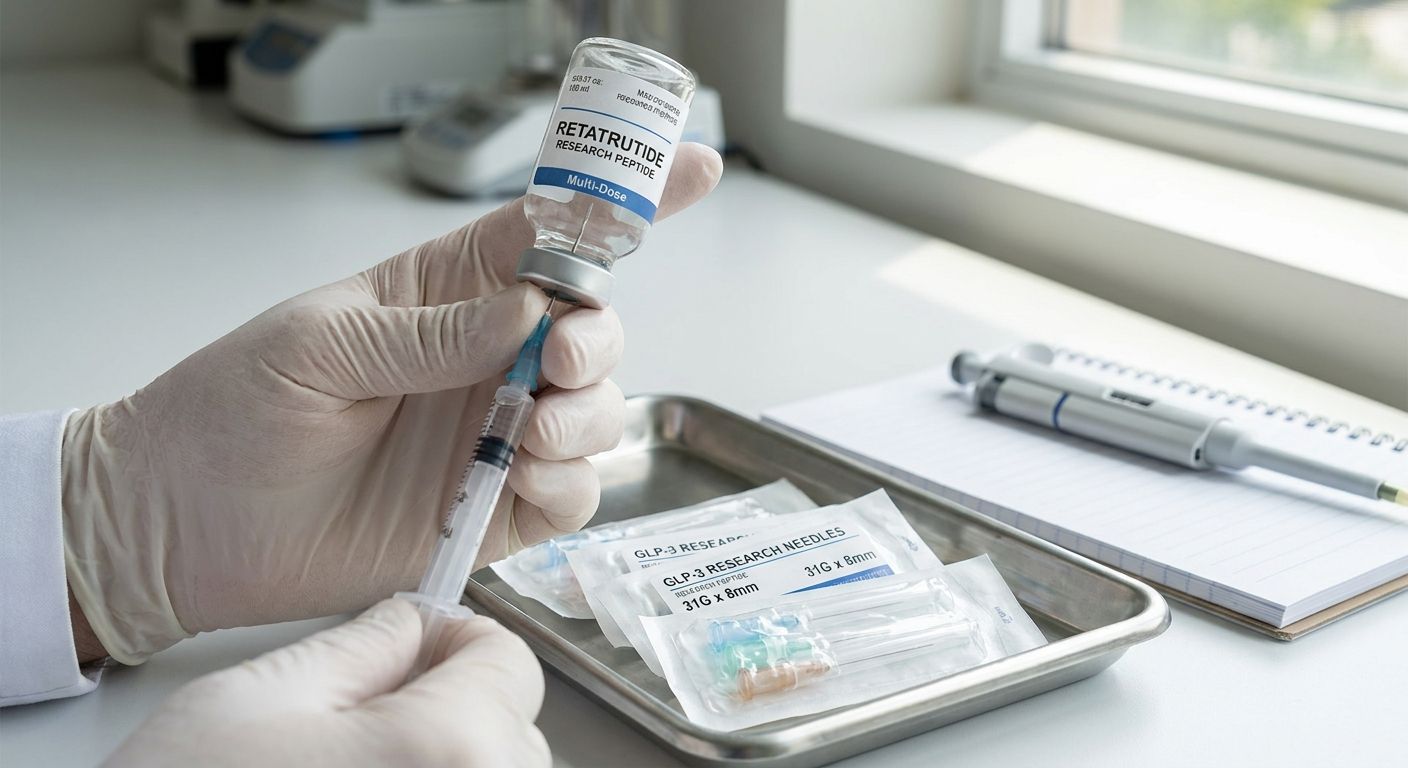
Retatrutide research vials ship as lyophilized powder, and every research protocol that reconstitutes them depends on picking the right needle and syringe combination before the bacteriostatic water ever touches the rubber septum. This guide breaks down what lab staff actually need for glp 3 needles selection in 2026, from gauge choice to sharps disposal.
- 21-gauge draw needles are the safe default for retatrutide research vial access in 2026 -- buy them.
- Thin-wall 29-30 gauge needles reduce coring risk on repeat septum punctures -- consider for multi-draw protocols.
- Low dead space syringes cut waste on small-volume aliquots; standard syringes are fine for bulk transfers.
- Reused or dulled needles are the top cause of septum coring reported across lab-handling guidance -- skip them every time.
Why this matters
Needle and syringe choice affects two things researchers care about: sample integrity and septum longevity. A needle that's too thick or too dull cores the rubber stopper, dropping rubber fragments into the solution and compromising the batch for downstream analysis.
A needle that's too thin slows the draw and increases the chance of foaming when pulling high-purity research peptides into solution. Getting the gauge and length right is a five-minute decision that saves an entire vial.
Who this is for
This guide is written for lab technicians, graduate researchers, and biotech staff who handle retatrutide research vials as part of reconstitution, aliquoting, or in-vitro protocol work. It assumes the peptide is used strictly for laboratory research, not for human administration, and that the reader already follows their institution's handling and disposal rules for 2026.
If you're sourcing supplies for a shared lab bench rather than a single project, the volume math and sharps logistics below scale differently -- factor that in before ordering a case of one gauge.
What to look for in needles for retatrutide research vial access
Needle gauge and wall thickness
Gauge determines flow rate and how cleanly the needle punctures the septum. Thicker needles (18-21G) draw bacteriostatic water fast with less foaming, which matters when a protocol calls for repeated reconstitutions in one session.
Thin-wall needles in the same gauge keep the outer diameter smaller while preserving bore size, reducing the puncture mark left on the septum. For research vials handled more than once, thin-wall construction extends how many draws a single vial's stopper can take before it fails.
Syringe volume and graduation clarity
A syringe with fine, legible graduation lines matters more than brand for accurate small-volume work. Reconstitution and aliquot protocols in 2026 lean on 1 mL and 3 mL syringes because they offer the graduation resolution needed for sub-milliliter transfers without guessing between lines.
Coarse graduations on larger syringes (10 mL and up) are fine for bulk transfer but useless for precision aliquoting.
Septum compatibility and coring risk
Repeated punctures in the same spot on a vial's rubber stopper cause coring -- small rubber fragments shearing off into the solution. A sharp, properly beveled needle tip lowers coring risk on every draw; a dulled or reused tip raises it sharply.
Rotating puncture points slightly across the septum surface, rather than hitting the same spot every time, extends the number of clean draws a single retatrutide research vial can support.
Sterility and single-use packaging
Individually sealed, single-use needles and syringes are the standard for any protocol drawing from high-purity research peptides -- reused needles introduce contamination risk that undermines the purity documentation that came with the vial in the first place.
Check that packaging is intact and the expiration date hasn't passed before use; sterility claims are void once a seal is broken.
Dead space and hub design
Low dead space (LDS) needle-syringe combinations trap less solution in the hub after a draw, which matters most when a vial's reconstituted volume is small and every fraction of a milliliter is accounted for in the protocol log.
Standard dead space syringes work fine for bulk transfers where a small residual loss doesn't affect downstream measurements.
Sharps disposal and safety
Every lab handling retatrutide research vials needs a compliant sharps container on the bench before the first draw, not after. Institutional biosafety rules in 2026 generally require puncture-resistant, labeled containers -- check your lab's specific protocol rather than assuming a generic container passes inspection.
Top picks for retatrutide research vial access
The workhorse -- 21-gauge draw needle. One spec that matters: 21G moves bacteriostatic water into the vial fast without excessive foaming, and it's the gauge most reconstitution protocols default to in 2026. Verdict: Buy for any lab doing routine reconstitution work.
The fine-transfer pick -- 29 to 30-gauge thin-wall needle. The thin wall keeps the puncture mark small even at this gauge, which extends septum life across repeat draws from the same vial. Verdict: Consider for labs running multi-draw protocols on a single research vial over several sessions.
The reconstitution companion -- bacteriostatic water for retatrutide research vials. Needle choice only solves half the problem; the diluent quality and preservative content matter just as much for solution stability once reconstituted. Verdict: Buy as the paired supply for any retatrutide reconstitution protocol.
The cross-protocol pick -- bacteriostatic water for tirzepatide reconstitution. Labs running both retatrutide and tirzepatide protocols in 2026 need separate, correctly-labeled diluent stock for each to avoid cross-contamination in record-keeping. Verdict: Consider if your bench handles more than one GLP-class research peptide.
The bulk-transfer pick -- standard 25-gauge multi-purpose needle. Useful for general lab draws that aren't going into a small-volume vial, but it's the wrong tool for precision retatrutide aliquoting. Verdict: Skip for retatrutide-specific work; keep it for other bench tasks.
Source your reconstitution supplies
Browse research peptide and bacteriostatic water listings for 2026 lab protocols.
What to avoid
- Reused needles. They look fine until the tip dulls, and a dulled tip is the leading cause of septum coring in repeat-draw protocols.
- Mismatched gauge for the task. An 18G needle built for fast bulk draws has no place in a sub-milliliter aliquot protocol where dead space and precision matter more than speed.
- Unlabeled diluent stock. Bacteriostatic water for one peptide protocol getting mixed up with another's is a record-keeping failure, not just a supply issue -- label every reconstituted vial the moment it's mixed.
Verdict comparison table
| Supply type | Gauge | Best for | Verdict |
|---|---|---|---|
| Standard draw needle | 21G | Routine reconstitution draws | Buy |
| Thin-wall transfer needle | 29-30G | Multi-draw septum protection | Consider |
| Low dead space syringe | N/A (paired with needle) | Small-volume aliquoting | Consider |
| General multi-purpose needle | 25G | Bulk, non-precision transfers | Skip for retatrutide work |
| Reused needle | Any | Nothing -- discard after single use | Skip |
FAQ
What gauge needle is best for retatrutide research vial access?
A 21-gauge needle is the standard default for drawing bacteriostatic water and accessing retatrutide research vials in 2026. Thin-wall 29-30 gauge needles are a better fit when a single vial needs multiple draws.
Is a thicker or thinner needle better for reconstitution?
Thicker needles like 21G draw faster with less foaming, while thinner thin-wall needles reduce the puncture mark on the septum. Pick based on how many times the same vial gets punctured across a protocol.
Can the same needle be used more than once on a research vial?
No -- reused needles dull quickly and raise the risk of coring the rubber septum, which contaminates the solution with rubber fragments. Single-use, sealed needles are standard practice for 2026 lab protocols.
What syringe size works best for retatrutide reconstitution?
1 mL and 3 mL syringes are the most common choices because their graduation lines give enough resolution for small-volume, precise transfers. Larger syringes are better suited to bulk transfer tasks, not fine aliquoting.
Do retatrutide and tirzepatide research vials need different bacteriostatic water?
They can use the same type of bacteriostatic water, but labs running both protocols should keep separate, clearly labeled stock to avoid cross-contamination in records. Mislabeled diluent is a common lab error, not a supply defect.
What is dead space and why does it matter for needle choice?
Dead space is the small amount of solution trapped in a needle-syringe hub after a draw, and low dead space (LDS) designs minimize that loss. It matters most on small-volume aliquots where every fraction of a milliliter is tracked in the protocol log.
How should used needles be disposed of in a research lab?
Used needles go into a puncture-resistant, labeled sharps container that meets your institution's biosafety rules for 2026. Check your specific lab's disposal protocol rather than assuming a generic container is compliant.
One last thing
The detail most labs skip: rotating the puncture point across the septum surface instead of hitting the same spot every draw. It costs nothing and it's the single easiest way to get more clean draws out of one retatrutide research vial before the stopper fails.