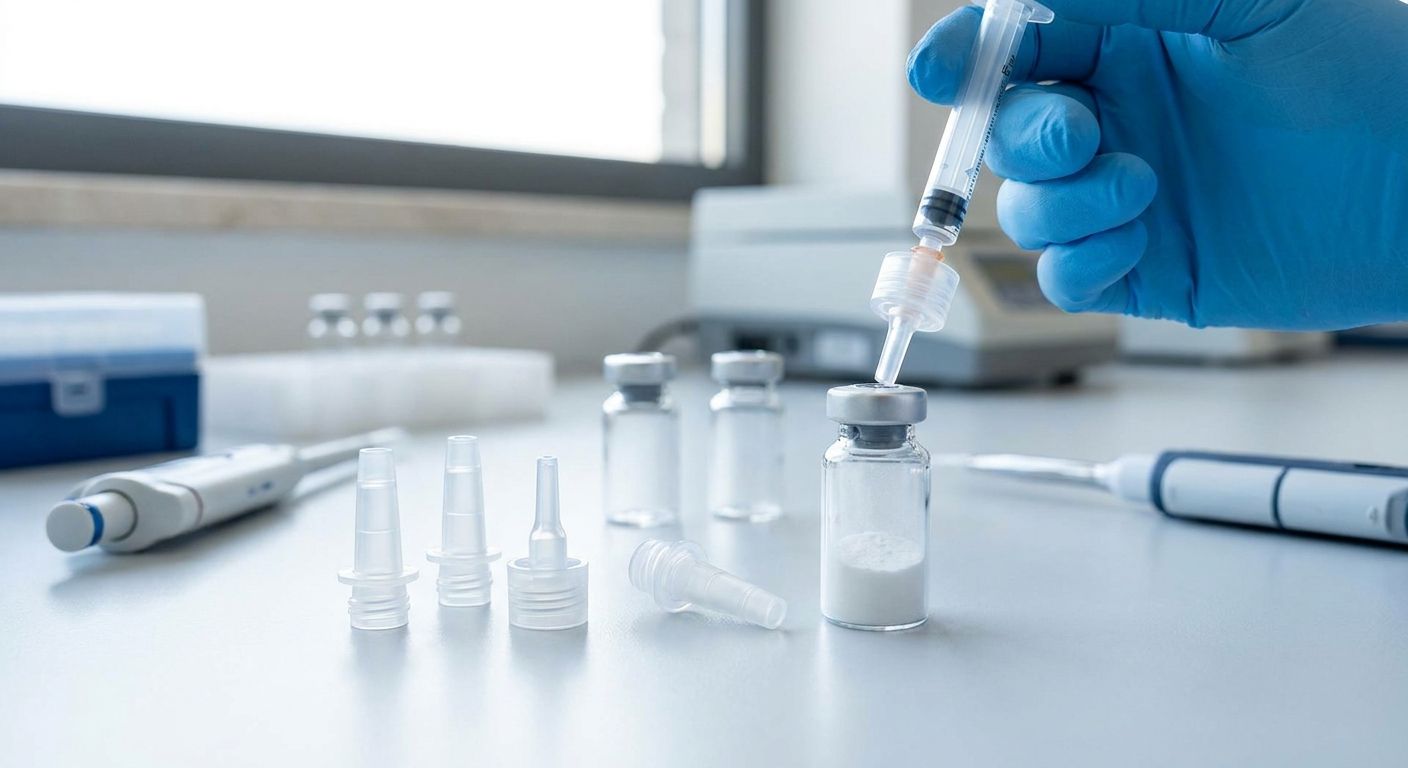
Vial adapters bridge a bacteriostatic water syringe and a lyophilized peptide vial without puncturing the same septum twice, and picking the wrong size or fitting stalls reconstitution in university labs, biotech benches, and contract research organizations alike.
- Vial adapters for peptide reconstitution work best in 13mm or 20mm luer-lock format matched to standard 2mL/3mL research vials — buy luer-lock over slip-tip.
- GLP-123's lab supplies bundle for GLP peptide reconstitution pairs adapters with bacteriostatic water and mixing syringes in one order — buy for new setups in 2026.
- Reused adapters across multiple reconstitution sessions compromise the septum seal — skip that shortcut entirely.
- CRO labs running batch reconstitution should pair adapters with 0.22 micron syringe filters, not treat filtration as optional.
Why this matters
A vial adapter is a small piece of hardware, but it decides how many times a septum gets pierced, whether a syringe seats cleanly, and whether a reconstitution run stays closed-system. Labs running semaglutide, tirzepatide, or retatrutide research protocols in 2026 are standardizing on adapters specifically because repeated needle punctures shred rubber septa and introduce coring fragments into solution. Research personnel at GLP-123 source adapters as part of a broader reconstitution kit rather than as a standalone afterthought, and that ordering pattern tells you something about how labs actually use them.
Who this is for
This guide is built for laboratory technicians, principal investigators, and procurement staff at university and biotech labs, plus analysts at contract research organizations, who reconstitute lyophilized research peptides on a recurring basis. It is not written for anyone reconstituting peptides for human use — every product referenced here is labeled for laboratory research only.
What to look for in vial adapters for peptide reconstitution
Vial neck size and crimp compatibility
Research peptide vials ship almost universally in 2mL or 3mL glass with either a 13mm or 20mm crimp-top neck. An adapter sized for a 20mm neck will not seat on a 13mm vial no matter how hard you press it, and a loose fit lets air leak past the septum during withdrawal. Check the vial neck diameter on your current inventory before ordering adapters in bulk.
Luer lock vs slip-tip fitting
A luer-lock adapter threads onto the syringe tip and locks with a quarter turn, which matters when you're pulling solution under any resistance. Slip-tip fittings pop off under pressure, and a popped fitting mid-withdrawal means re-gowning and re-swabbing before you try again. Luer lock costs almost nothing extra and removes an entire failure mode.
Material and chemical compatibility
Bacteriostatic water and most reconstitution diluents are inert toward standard polycarbonate and polypropylene adapter housings, but the silicone septum inside is the actual point of contact and the part that degrades fastest. A septum rated for single-use holds its seal integrity for one draw; pushing it past that spec is where contamination risk creeps in.
Sterility and single-use design
Adapters that ship individually sealed and rated single-use remove the guesswork of tracking reuse across a research log. Multi-use adapters exist and cost less per unit, but every lab that has audited a contamination event traces it back to a septum that got used more times than its rating allowed.
Compatibility with your reconstitution syringe and needle
An adapter is only half the interface — the syringe and needle on the other end need to match luer format and gauge. Labs standardizing on a mixing syringe workflow get consistent draw volumes because every component in the chain shares the same fitting, instead of mixing luer-slip syringes with luer-lock adapters and forcing connections.
Top picks for research reconstitution setups
The safe pick: standard 13mm luer-lock adapter paired with a documented mixing protocol. This is the setup most university and biotech labs land on because it fits the majority of commercial peptide vial format and eliminates connection failures. Pair it with a written mixing syringe protocol so every technician runs the same sequence. Verdict: Buy.
The bundle pick: a full reconstitution kit instead of piecing components separately. GLP-123's lab supplies bundle for GLP peptide reconstitution groups adapters with bacteriostatic water and mixing syringes into one order, which cuts the chance of ending up with mismatched luer fittings across your bench. Labs standing up a new reconstitution station in 2026 default to this over sourcing three separate SKUs. Verdict: Buy.
The high-throughput pick: 20mm adapters plus in-line filtration for CRO volume. Contract research organizations running batch reconstitution across dozens of vials per week benefit from the larger 20mm format paired with syringe filtration on the draw side, not just the adapter. Skipping the filter step to save thirty seconds per vial is the most common corner cut on high-volume benches. Verdict: Buy for CRO throughput, Consider for occasional single-vial use.
The wildcard: single-use adapters for retatrutide triple-agonist protocols. Retatrutide research vials see more frequent access in multi-arm studies, and a single-use adapter per session avoids stacking punctures on the same septum across a study timeline. This costs more per reconstitution than a reusable setup but removes a documented failure point. Verdict: Consider for multi-arm studies, Skip if your protocol only calls for one draw per vial.
Set up your reconstitution bench
Order adapters, bacteriostatic water, and mixing syringes in one bundle.
What to avoid
- Reused adapters across sessions. An adapter rated single-use that gets reseated for a second or third draw has a septum that no longer forms a full seal, and that's where air and contaminants get pulled in.
- Mismatched neck sizes forced into place. Pressing a 13mm adapter onto a 20mm vial (or the reverse) with extra force cracks the crimp ring or misaligns the septum, and neither failure is visible until you're mid-draw.
- Slip-tip adapters on high-viscosity diluents. Anything thicker than standard bacteriostatic water increases withdrawal resistance, and a slip-tip fitting under that resistance is the setup most likely to disconnect.
Comparison across criteria
| Setup | Vial fit | Fitting type | Reuse risk | Best for |
|---|---|---|---|---|
| Standard 13mm luer-lock | 13mm crimp vials | Luer lock | Low if single-use | General lab reconstitution |
| Bundle kit | 13mm/20mm mixed | Luer lock | Low, kit-standardized | New reconstitution stations |
| 20mm + syringe filter | 20mm crimp vials | Luer lock | Low with filtration | CRO batch throughput |
| Single-use for multi-arm studies | 13mm/20mm | Luer lock | Lowest, one draw per unit | Retatrutide/multi-arm protocols |
FAQ
What is a vial adapter used for in peptide reconstitution?
A vial adapter lets a syringe connect to a lyophilized peptide vial through one controlled port instead of repeated needle punctures through the septum. This reduces septum coring and keeps the reconstitution process closer to a closed system in laboratory research settings.
What size vial adapter do I need for research peptide vials?
Most research peptide vials use a 13mm or 20mm crimp-top neck, and the adapter must match that exact diameter. Check the vial packaging or supplier listing before ordering, since a 13mm adapter will not seat on a 20mm vial.
Is luer lock or slip-tip better for vial adapters?
Luer lock is better for vial adapters because it threads and locks onto the syringe, holding under withdrawal pressure. Slip-tip fittings can disconnect mid-draw, which forces you to re-swab and restart the reconstitution step.
Can vial adapters be reused across multiple reconstitutions?
Single-use adapters are rated for one draw because the septum seal degrades after that. Reusing them across multiple sessions increases contamination risk, which is why most labs treat adapters as consumable per vial, not per study.
Do vial adapters work with all research peptides like semaglutide, tirzepatide, and retatrutide?
Yes, vial adapters are sized to the vial format, not the peptide inside it, so a 13mm or 20mm adapter works across semaglutide, tirzepatide, and retatrutide research vials as long as the neck size matches.
What else do I need besides a vial adapter for reconstitution?
You need bacteriostatic water, a mixing syringe, and typically a needle sized to your draw volume alongside the adapter. Bundled kits group these together so every component shares the same luer fitting.
Are vial adapters sterile out of the box?
Single-use adapters intended for laboratory research ship individually sealed and sterile until opened. Confirm sterile packaging on the listing before ordering, since not every adapter format ships that way.
One last thing
The detail that trips up new lab setups in 2026 isn't the adapter itself, it's neck size drift across suppliers — two vials labeled the same volume can still ship on 13mm or 20mm crimp tops depending on the manufacturer, so verify neck diameter per batch rather than assuming it carries over from your last order.