Tirzepatide research vials degrade fastest from bad freezer habits, not bad chemistry — the wrong appliance or a few freeze-thaw cycles can wreck a batch before a single protocol runs. This guide breaks down what actually protects lyophilized and reconstituted vials in 2026 and what setups quietly ruin them.
- Manual-defrost freezers at a stable -20°C are the standard for tirzepatide freezer storage in 2026 — buy this setup.
- Frost-free upright freezers cycle temperature every few hours and stress lyophilized peptide — consider, don't default.
- Reconstituted tirzepatide belongs in a 2-8°C refrigerator, not the freezer, and gets used within its stability window.
- Ultra-low -80°C freezers are overkill for standard research timelines unless a protocol specifically calls for multi-year storage.
- Countertop mini freezers and fridge-door shelves fail on temperature consistency — skip both for vial storage.
Why this matters
Lyophilized tirzepatide is stable because it's dry — the moment it's reconstituted or exposed to temperature swings, the clock starts. A lab tech who leaves a vial in a frost-free freezer that cycles between -15°C and -22°C every defrost run is running an uncontrolled variable into every downstream measurement. Freezer choice isn't a shipping detail, it's a research-integrity detail.
This is the difference between a freezer that holds temperature within a degree or two and one that swings 5-7°C on a schedule. For anyone running tirzepatide research peptide protocols where consistency across samples matters, that swing shows up as noise you can't explain later.
Who this is for
This guide is for lab managers, university research groups, and biotech buyers who order tirzepatide research vials in bulk and need a storage protocol that holds up across multiple freeze-thaw cycles and multi-week studies. If a single vial gets used once and discarded, storage discipline matters less. If vials get pulled, reconstituted, and re-stored repeatedly over a 2026 study timeline, the freezer setup becomes part of the experiment.
What to look for in freezer storage for tirzepatide research vials
Temperature stability, not just a temperature number
A freezer rated for -20°C isn't the same as a freezer that holds -20°C. Cheap units drift 3-5°C during compressor cycles, and that drift is invisible unless you're logging it. For research vials, stability across 24 hours matters more than the number on the dial.
Manual defrost over frost-free
Frost-free freezers work by periodically warming the interior to melt ice buildup, which means every unit on the market cycles above its set point on a schedule — often every 6-8 hours. That's fine for food. It's a repeated thermal stress event for a lyophilized peptide vial sitting in the back of the compartment.
Light protection inside the unit
Peptides degrade faster under light exposure, and most freezers aren't opaque when the door opens multiple times a day in a shared lab. Amber vials help, but an opaque storage box inside the freezer adds a second layer of protection that costs nothing.
Separation from reconstituted stock
Reconstituted tirzepatide should never share freezer space with lyophilized stock — it belongs in refrigeration at 2-8°C, not below freezing, and mixing the two storage types in one unit is how techs grab the wrong vial mid-protocol.
Documented temperature logs
Any lab running formal research protocols in 2026 should have a temperature log on the storage unit, whether that's a built-in data logger or a manual check sheet. If a funding body or journal ever asks how storage was controlled, "we assumed it stayed cold" isn't an answer.
Backup power or alarm on the unit
A freezer that loses power for six hours during a weekend outage can undo weeks of careful cold-chain handling from the point the vials arrived. A plug-in freezer alarm or a unit on backup power closes that gap.
Get tirzepatide vials shipped cold
Cold-chain shipping keeps vials stable from dispatch to your freezer.
Storage setups ranked
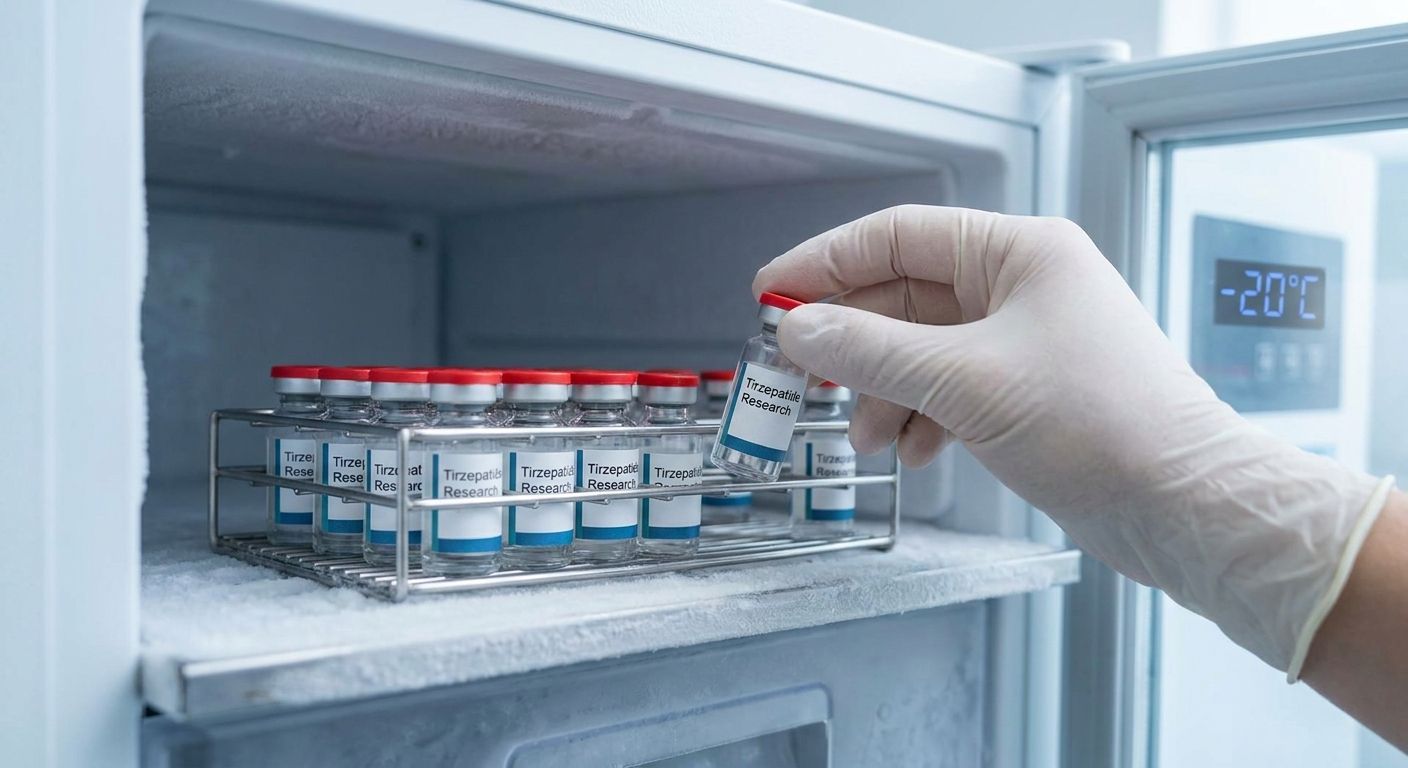
Manual-defrost chest freezer at -20°C — the standard pick. Chest freezers hold temperature far more evenly than uprights because cold air sinks and stays put when the lid opens, and manual-defrost models never run a warming cycle. Vials stored here stay within 1-2°C of set point across a normal week. Buy — this is the baseline setup for any lab running tirzepatide research through 2026.
Frost-free upright freezer — the risky convenience pick. Easy to organize, easy to access, and cycling 5-7°C above set point every 6-8 hours to clear frost. Fine for short-term storage under a week, weak for anything longer. Consider only if vials rotate out fast; Skip for multi-week protocols.
Refrigerator freezer compartment — the budget stopgap. The small freezer box on top of a standard fridge holds roughly -15 to -18°C and swings more than a dedicated freezer because the compressor is shared with the fridge side. It works in a pinch for a handful of vials. Consider for short-term or backup use, not primary storage.
Ultra-low -80°C freezer — the overkill pick. Built for long-term biological sample banking, not standard tirzepatide research timelines. Unless a protocol specifically calls for multi-year storage stability, the added cost and energy draw don't buy anything a -20°C manual-defrost unit doesn't already deliver. Skip unless your study design demands it.
Countertop mini freezer — the dorm-room mistake. Small compressor, poor insulation, and temperature swings that can exceed 10°C depending on ambient room temperature and how often the door opens. Not built for consistent sub-zero storage. Skip.
What to avoid
- Repeated freeze-thaw cycles. Pulling a vial out, letting it warm, and refreezing it more than once degrades the peptide structure faster than continuous cold storage ever would.
- Fridge door storage. The door is the warmest, most temperature-variable part of any refrigerator — never store reconstituted vials there even though the shelf looks convenient.
- Clear glass or unshaded storage bins. A freezer that looks organized with vials in a clear bin under interior light is still exposing peptide to light every time the door opens.
Once a vial is reconstituted, timing matters as much as temperature. Pair the storage setup with bacteriostatic water for tirzepatide handled correctly at reconstitution, and track the ~30-day refrigerated stability window before it's outside spec.
Verdict comparison table
| Setup | Temp stability | Defrost cycle risk | Cost | Verdict |
|---|---|---|---|---|
| Manual-defrost chest freezer | Excellent (±1-2°C) | None | Moderate | Buy |
| Frost-free upright freezer | Poor (±5-7°C) | High, every 6-8 hrs | Moderate | Consider/Skip |
| Fridge freezer compartment | Fair (±3-5°C) | Moderate | Low | Consider (backup only) |
| Ultra-low -80°C freezer | Excellent | None | High | Skip (overkill) |
| Countertop mini freezer | Poor (±10°C) | High | Low | Skip |
FAQ
What is the best freezer temperature for tirzepatide research vials?
Lyophilized tirzepatide research vials store best at a stable -20°C. Once reconstituted, vials move to refrigeration at 2-8°C, not the freezer, for the remainder of the stability window.
Is a frost-free freezer bad for tirzepatide storage?
Frost-free freezers cycle 5-7°C above their set point every 6-8 hours to clear ice buildup, which stresses lyophilized peptide over multi-week storage. A manual-defrost freezer avoids this cycling entirely.
Can reconstituted tirzepatide go back in the freezer?
No. Reconstituted tirzepatide belongs in refrigeration at 2-8°C, not below freezing. Refreezing a reconstituted vial introduces a freeze-thaw cycle that degrades peptide structure.
How long does reconstituted tirzepatide stay stable in the fridge?
Reconstituted peptide typically holds stability for roughly 30 days under refrigeration at 2-8°C. Vials past that window should be treated as outside spec for research use.
Do I need an ultra-low -80°C freezer for tirzepatide research?
Most standard research timelines don't require -80°C storage. A -80°C freezer only earns its cost when a protocol specifically calls for multi-year sample banking.
Does light exposure affect tirzepatide vials in freezer storage?
Yes. Peptides degrade faster under light exposure, so storing vials in an opaque box inside the freezer adds protection beyond the amber vial itself.
What happens if a freezer loses power overnight?
A power loss of several hours can undo weeks of controlled cold-chain handling from the point vials arrived. A plug-in freezer alarm or backup power source closes that risk.
One last thing
The detail most labs skip in 2026 isn't the freezer, it's the log. A $15 plug-in thermometer with min/max memory tells you in seconds whether last night's power blip pushed the unit above -15°C — without one, every vial pulled after an unnoticed outage is a guess, not data.