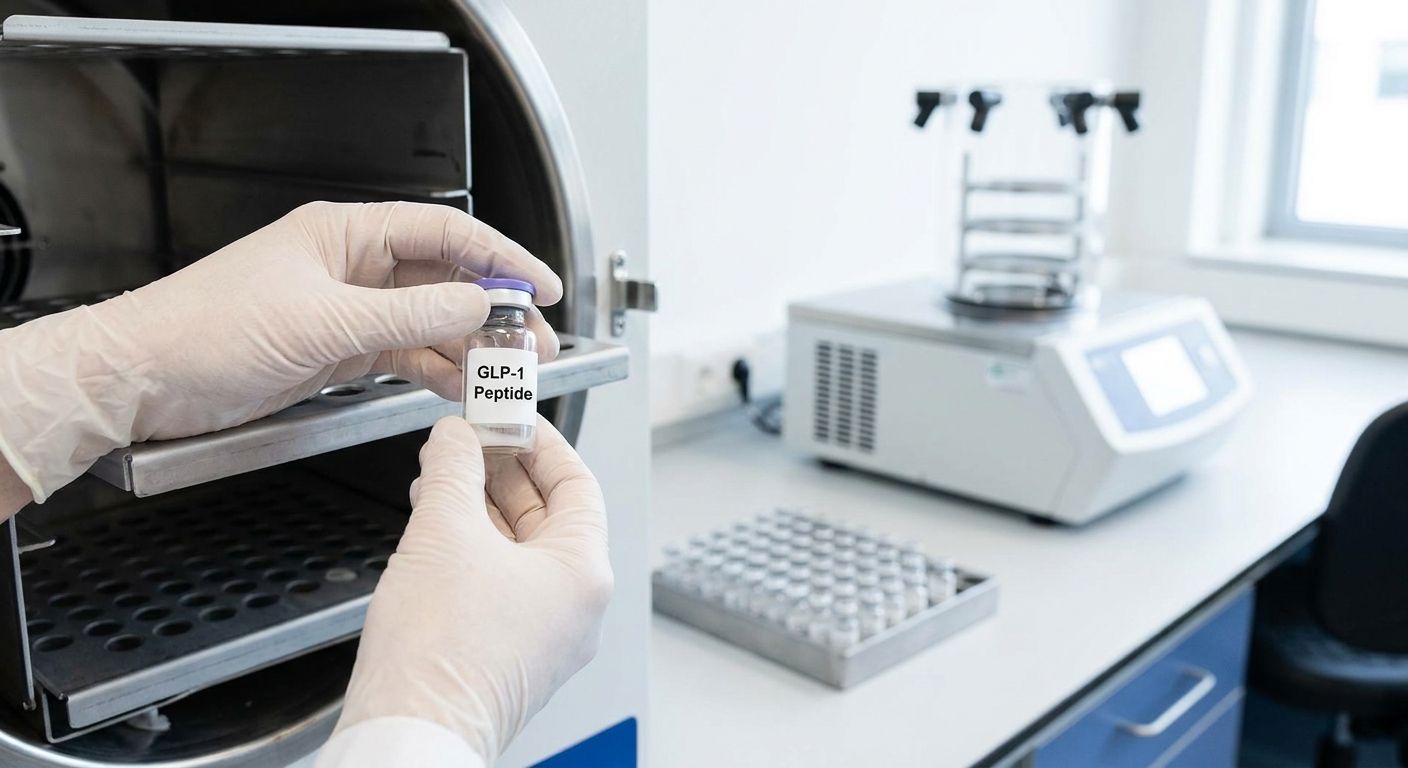
Contract research organizations buying peptides for metabolic, endocrine, or obesity studies need documentation and cold-chain discipline a general lab supply catalog doesn't provide — this guide breaks down what to check before you commit a purchase order to a vendor for 2026 studies.
- Research peptides for CROs require a certificate of analysis per lot, not per product line — Glp-123's tirzepatide and retatrutide pages disclose this at the SKU level.
- Lyophilized peptides degrade fast above -20°C; cold-chain shipping is the deciding factor for usable 2026 study data, not an add-on.
- Retatrutide research peptide for triple agonist studies is the pick for labs comparing GIP/GLP-1/glucagon pathways — Buy for that use case.
- Skip any vendor that bundles reconstitution supplies as an afterthought instead of a documented protocol.
Why this matters
A CRO's data is only as good as the material behind it. If a peptide arrives without a lot-specific COA, or if it sat in an unrefrigerated shipping box for two days, the study results are compromised before the first assay runs. Procurement teams at Glp-123 treat purity documentation and cold-chain handling as separate line items because they fail independently — a peptide can be 98% pure on paper and still degrade in transit.
The stakes are higher in 2026 than they were even two years ago. GLP-1, GIP, and multi-agonist research has scaled fast, and CROs are running comparative studies across compound classes that didn't exist commercially five years ago. That means procurement now has to vet triple-agonist peptides like retatrutide alongside established GLP-1 research peptides, often from the same vendor relationship.
Who this is for
This guide is for procurement leads and lab managers at contract research organizations, university labs, and biotech research teams sourcing peptides for in vitro or animal-model metabolic studies in 2026. If you're ordering on a purchase-order cycle, need lot-level documentation for an internal audit trail, and can't tolerate a shipment sitting at ambient temperature over a weekend, this is written for your buying criteria specifically — not for individual researchers making one-off purchases.
What to look for in research peptides for CROs
Certificate of analysis per lot
A CRO can't cite a peptide in a published protocol without traceable purity data tied to the specific lot received, not a generic product-page claim. Vendors that publish HPLC purity figures (typically ≥98% for commercial research peptides) at the lot level let your team attach that documentation directly to a study file. Anything less turns every order into a documentation gap you'll have to explain later.
Cold-chain shipping as standard, not premium
Lyophilized peptides are chemically stable at -20°C storage but start degrading once they warm past that threshold for extended periods. If cold-chain packaging is an upsell option instead of the default shipping method, that's a signal the vendor doesn't understand what a compromised shipment costs a CRO in wasted study time.
Reconstitution supplies sold alongside the peptide
Bacteriostatic water and reconstitution syringes aren't incidental — a peptide vial without a matched reconstitution kit sitting in the same catalog forces your lab to source sterile diluent separately and introduces a second point of failure. Vendors that list bacteriostatic water for tirzepatide reconstitution next to the peptide itself are building for lab workflow, not just a transaction.
Compound breadth for comparative studies
Most 2026 metabolic research protocols don't test one compound in isolation — they compare a GLP-1 agonist against a dual or triple agonist across the same assay. A vendor carrying tirzepatide, retatrutide, and semaglutide-adjacent supplies under one account cuts down the number of vendor relationships your procurement team has to manage and audit.
Bulk and repeat-order pricing transparency
CROs order on a recurring basis tied to study timelines, not one-time. Pricing that's opaque until checkout or that changes without notice makes budget forecasting for a multi-quarter study nearly impossible.
Order documentation that survives an audit
Every invoice, COA, and shipping manifest needs to be retrievable months after the order ships, because institutional review and internal QA processes at CROs and university labs run on a longer timeline than the purchase itself.
Top picks for CRO procurement in 2026
The metabolic workhorse: Tirzepatide research peptide for metabolic studies. This is the compound most CRO metabolic protocols are built around right now, and it's the page to start with if your study design centers on dual GIP/GLP-1 receptor activity. The listing carries lot-specific purity documentation, which is the single non-negotiable for citing results in a formal study report. Verdict: Buy — this is the default entry point for GIP/GLP-1 comparative work in 2026.
The newest agonist on the order sheet: Retatrutide research peptide for triple agonist studies. Retatrutide targets GIP, GLP-1, and glucagon receptors simultaneously, which makes it the compound CROs reach for when a protocol needs to isolate glucagon-pathway effects against dual-agonist baselines. It's a newer addition to most research catalogs, so lot availability and COA turnaround matter more here than with established compounds. Verdict: Buy for labs running triple-agonist comparative work; Consider if your protocol only needs dual-agonist data, since tirzepatide covers that at a lower per-study cost.
The baseline audit page: High-purity peptides for laboratory research protocols. This is where procurement should check documentation standards before placing a first order — it's the page that shows how purity data is disclosed across the catalog, not just on a single SKU. Verdict: Buy — use this page as the procurement checklist before committing to a vendor relationship for 2026 studies.
The logistics gate: Cold chain shipping for lyophilized research peptides. This isn't a product, it's the shipping protocol that determines whether every other pick on this list arrives usable. A peptide with a perfect COA is worthless if it spent 48 hours at ambient temperature in transit. Verdict: Buy-in required — confirm this is the default shipping method before your first purchase order, not an option you select at checkout.
What to avoid
- Vendors that publish purity claims only at the product-line level, not per lot. It looks like a purity guarantee but it's not traceable to what actually arrives in your shipment — you need the lot number tied to the COA.
- Ambient shipping with cold packs as an add-on fee. This looks like a cost-saving option but it shifts the degradation risk onto your study timeline, and a failed study costs far more than the shipping upgrade would have.
- Single-compound vendors when your protocol needs comparative data. A catalog that only carries one GLP-1 compound forces you to open a second vendor account mid-study, which multiplies your documentation and audit burden for no research benefit.
Check catalog documentation before ordering
Review lot-level purity data across university and biotech lab orders.
Verdict comparison
| Criteria | Tirzepatide research peptide | Retatrutide research peptide | High-purity peptides page | Cold chain shipping |
|---|---|---|---|---|
| Lot-level COA | Yes | Yes | Catalog-wide standard | N/A — logistics only |
| Best for | GIP/GLP-1 comparative studies | Triple-agonist comparative studies | Procurement vetting | Every shipment, 2026 onward |
| Verdict | Buy | Buy for triple-agonist work | Buy | Buy-in required |
FAQ
What should a CRO check before ordering research peptides in 2026?
A CRO should confirm a lot-specific certificate of analysis, cold-chain shipping as the default method, and matched reconstitution supplies before placing an order. Skipping any of these three turns a routine purchase into a documentation or degradation risk.
Is retatrutide better than tirzepatide for research studies?
Neither is universally better — retatrutide targets GIP, GLP-1, and glucagon receptors while tirzepatide targets GIP and GLP-1 only. The right choice depends on whether your protocol needs triple-agonist or dual-agonist comparative data.
How much does cold-chain shipping matter for lyophilized peptides?
It matters enough to determine whether a shipment is usable at all. Lyophilized peptides are stable at -20°C storage but degrade once exposed to ambient temperature for extended transit periods.
Do university labs need the same documentation as commercial CROs?
Yes — university labs publishing or citing results in institutional review need the same lot-level COA traceability that commercial CROs require for audit purposes.
What reconstitution supplies does a peptide order need?
A peptide order needs bacteriostatic water and a reconstitution syringe matched to the vial size, sourced alongside the peptide rather than separately to avoid a second point of failure.
Can a single vendor supply multiple compound classes for comparative studies?
Some vendors carry tirzepatide, retatrutide, and related supplies under one catalog, which reduces the number of separate vendor relationships a CRO has to audit for a single multi-compound study.
What purity level should research peptides carry in 2026?
Most commercial research peptides disclose HPLC purity at or above 98%, documented per lot rather than as a general product claim.
One last thing
The detail procurement teams miss most often isn't purity — it's the reconstitution kit. A vial with a flawless COA still needs bacteriostatic water and a matched syringe on hand the day it arrives, and ordering those separately from a different supplier introduces a lot-tracking gap nobody catches until an audit asks for it. Order the diluent and the peptide from the same catalog entry when the option exists.